Complex Numbers
Overview
The set
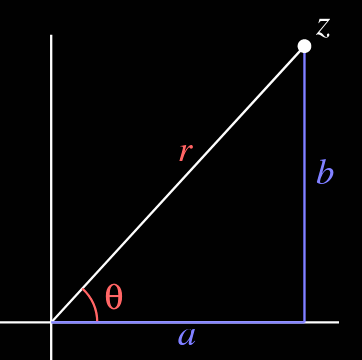
For any complex number of the form
The modulus of
Conjugates
Let
Arithmetic
Addition, subtraction, and multiplication of complex numbers are done in the normal way. Division works with the aid of conjugates.
Addition
For complex numbers
Subtraction
For complex numbers
Multiplication
For complex numbers
Division
For complex numbers
Bibliography
- “Complex Plane,” in Wikipedia, December 14, 2024, https://en.wikipedia.org/w/index.php?title=Complex_plane.
- John B. Fraleigh, A First Course in Abstract Algebra, Seventh edition, Pearson new international edition (Harlow: Pearson, 2014).
- Ted Sundstrom and Steven Schlicker, Trigonometry, 2024.
- Tom M. Apostol, Calculus, Vol. 1: One-Variable Calculus, with an Introduction to Linear Algebra, 2nd ed. (New York: Wiley, 1980).
- Wikipedia. “Argument (complex analysis).” August 3, 2025. https://en.wikipedia.org/w/index.php?title=Argument_(complex_analysis).