The natural exponential function refers to a function that applies exponentiation with Euler's number as the base. That is, a function of form for some . This is alternatively denoted as .
More generally, an exponential function refers to any function of form where . and . General exponential functions are defined in terms of natural exponential functions via the following identity:
Radicals
A radical refers to an th root of denoted as . The positive integer is called the index or degree. The number of which the root is taken is the radicand.
Rationalization is a process by which radicals are eliminated from an expression. An expression of form is rationalized by multiplying by its conjugate .
Complex
If , we define to be the complex number given by
Every complex number can be expressed in polar form where and for any .
Euler's formula is a specialization of the above definition where the real portion of the complex number is :
Multiplication
Let and . Then
Division
Let and . If , then
De Moivre's Theorem
Let be a complex number and be any integer. Then
Roots
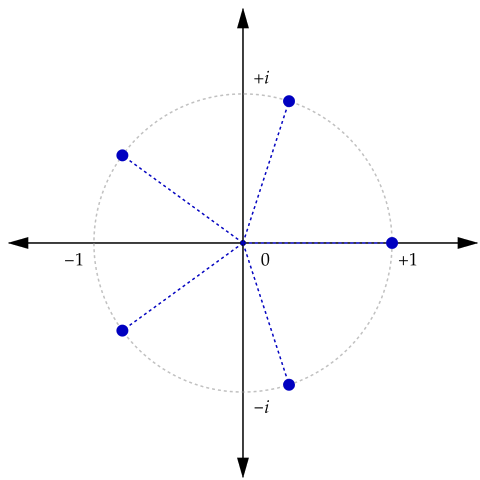
Let be a complex number. Then, for , the th roots of are given by
The solutions to are called the th roots of unity.