Polynomials
Overview
Let
where
We denote the set of all polynomials in an indeterminate
Quadratics
A quadratic function (of a single variable) is a function of the form
where
- If
, is concave upward. - If
, is concave downward. - The axis of symmetry is
.
A quadratic may have zero, one, or two real roots. It will always have exactly two complex roots. In both cases, these refer to the points
Completing the Square
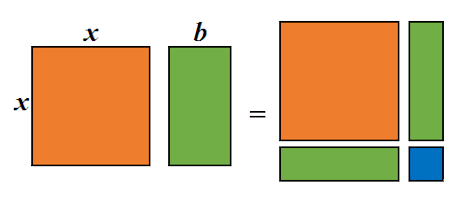
Completing the square is a technique for converting a quadratic polynomial in standard form to that of vertex form
Quadratic Formula
Let
The portion under the radical is called the discriminant. If
- the discriminant is positive,
has two real roots; - the discriminant is negative,
has two complex roots; - the discriminant is zero,
has one real repeated root.
Long Division
Polynomial long division is an algorithm for dividing a polynomial by another with equal or lower degree.
We say a rational function is proper if the degree of the numberator is less than that of the denominator. Otherwise we say it is improper. An improper rational function can be expressed as the sum of a polynomial and a proper rational function using long division.
Algebraic Numbers
The set of polynomials with coefficients in
A number