The natural exponential function refers to a function that applies exponentiation with Euler's number as the base. That is, a function of form for some . This is alternatively denoted as .
More generally, an exponential function refers to any function of form where . and . General exponential functions are defined in terms of natural exponential functions via the following identity: $$b^x = e^{x\ln{b}}$$
Complex
If , we define to be the complex number given by $$e^z = e^x(\cos{y} + i\sin{y}).$$
Every complex number can be expressed in the form where and for any . This representation is called the polar form of .
Multiplication
Let and . Then $$wz = rs[\cos{(\alpha + \beta)} + i\sin{(\alpha + \beta)}].$$
Division
Let and . If , then $$\frac{w}{z} = \frac{r}{s}[\cos{(\alpha - \beta)} + i\sin{(\alpha - \beta)}].$$
De Moivre's Theorem
Let be a complex number and be any integer. Then $$z^n = r^n\left[ \cos{(n\theta)} + i\sin{(n\theta)} \right].$$
Roots
Let be a complex number. Then, for , the th roots of are given by $$\large \sqrt[n]{r} \left[ \cos{\left( \frac{\theta + 2\pi k}{n} \right)} + i\sin{\left( \frac{\theta + 2\pi k}{n} \right)} \right].$$
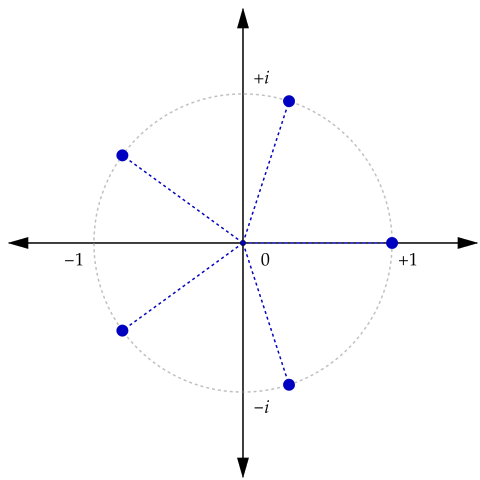
The solutions to are called the th roots of unity.
Bibliography
Ted Sundstrom and Steven Schlicker, Trigonometry, 2024.
Tom M. Apostol, Calculus, Vol. 1: One-Variable Calculus, with an Introduction to Linear Algebra, 2nd ed. (New York: Wiley, 1980).