Let be a ring with unity . If every nonzero element of is a unit, then is a skew field (or division ring). is a field if it is a commutative division ring. is a strictly skew field if is a noncommutative division ring.
Let and be fields. A field homomorphism is a mapping that satisfies the following conditions for all :
Note that is also a ring homomorphism so the linked structural properties are preserved. Additionally,
TODO
Special Cases
Rationals
The set of all rationals is denoted . The following notation is often used to denote particular subsets of :
Reals
The set of all real numbers is denoted . The following notation is often used to denote particular subsets of :
for .
.
.
Complex
The set of all complex numbers is a field, denoted . It is defined as
where is the imaginary number given by . Addition, subtraction, and multiplication are performed in the normal way. Division works with the aid of conjugates.
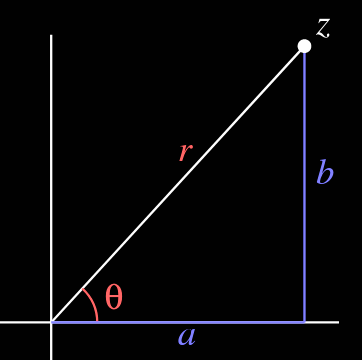
For any complex number of the form , , the number is called the real part of and the number is called the imaginary part of . This is denoted as and respectively.
The modulus of , denoted , is defined as . The argument of , denoted , is the angle between the complex number and the positive real axis.
Conjugates
Let be a complex number. Then its complex conjugate, denoted as , is defined as
Arithmetic
The normal arithmetic operations hold in . If where and ,