If and are events with , then the conditional probability of given , denoted by , is defined as
Let be a set of observed events. Generalizing, we say
is the prior probability of whereas is the posterior probability of . The symbol bar used to separate the event whose probability is being updated is called the conditioning bar.
Bayes' Theorem
Let be a probability space and be events with positive probabilities. Then Bayes' theorem states that
Odds Form
For any events and with positive probabilities, the odds of after conditioning on are
In other words, the posterior odds are equal to the prior odds times the likelihood ratio.
Law of Total Probability
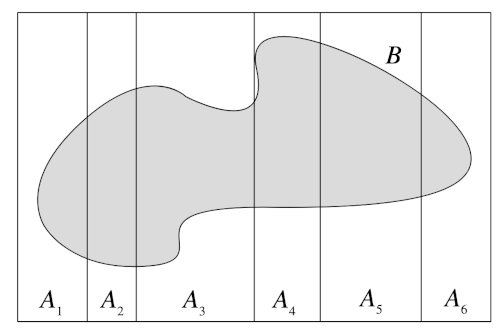
Let be a partition of sample space , with for all . Then
Coherency
Bayesian reasoning is coherent meaning new information, i.e. evidence, can be incorporated sequentially or simultaneously without affecting the result.
Reasoning
Reasoning refers to the decision-making process made in the wake of probabilistic events. A number of biases exist innately that yield "paradoxes" hard to reason about, especially in light of conditional data.
Consider . If is perceived as a cause of the occurrence of , we refer to as a causal datum. If is instead treated as a possible cause of , we refer to as a diagnostic datum. Otherwise we refer to as an incidental datum.
Notice in normative analysis, the distinction between causal, diagnostic, and incidental is irrelevant. This is purely a psychological perspective that explains biases humans tend to have around conditional reasoning.
Cromwell's Rule
Cromwell's rule is the principle stating one should avoid assigning probabilities of or to any event (except mathematical certainties).
Let with . If , then . Likewise, if , then . In other words, if someone were to believe an event is to occur with absolute certainty, no amount of evidence can be used to change their mind.