Combinations
Overview
A
Pascal's Triangle
Pascal's triangle is a visual representation of binomial coefficients. The top of the triangle looks as follows:
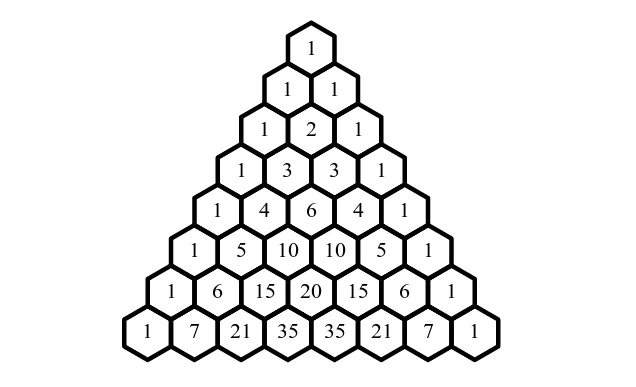
Each term is generated by adding the two terms above it, formalized via recurrence $$\binom{n}{k} = \binom{n - 1}{k} + \binom{n - 1}{k - 1}$$
Stars and Bars
The stars and bars chart refers to a graphical depiction of distributing
Notice there are
Binomial Theorem
Let
In a commutative rng, the following identity, which forgoes terms
Freshman Exponentiation
Let
Identities
Hockey stick Identity
Let
Vandermonde's Identity
Let
Common Examples
Bit Strings
A bit string can be used to represent subsets of some finite set. A 1 value usually corresponds to inclusion in a subset, whereas a 0 value corresponds to exclusion. Thus, given set e.g.
Bit strings also make it clear that the number of subsets with even cardinality must be equal to the number of subsets with odd cardinality. Hence,
Lattice Paths
A lattice path is one of the shorted possible paths connecting two points on a lattice, moving only horizontally and vertically. By representing each horizontal move by 1 and each vertical move by 1, we see every lattice path has a corresponding bit string.
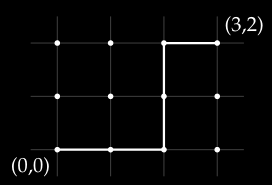
In this example, the total number of lattice paths from point