Let be a function defined on some open interval . The derivative of , denoted or , is given by
provided this limit exists. The fraction we are taking the limit on is known as the difference quotient.
Differentials
Leibniz preferred the following notation for defining a derivative:
is called the difference operator, and are called differentials, and the derivative is called a differential quotient.
The differential quotient was the quotient of infinitesimal quantities Leibniz imagined as entirely new numbers greater than zero but smaller than every positive real number.
Identities
The following identities assume and are functions defined on a common interval. Assume their derivatives are defined at point . Then:
Addition
Subtraction
Multiplication
Also known as the product rule. $$(f \cdot g)'(x) = f'(x)g(x) + f(x)g'(x)$$
Division
Chain Rule
Suppose is differentiable at and is differentiable at . Then is differentiable at and
Implicit Differentiation
Implicit differentiation refers to the differentiation of an implicit function. They leverage the chain rule by maintaining that the value of the function is defined in terms of the others as arguments.
Logarithmic Differentiation
Let be a differentiable function and define . Then, by virtue of the chain rule,
Continuity
Let be a function differentiable at . Then is continuous at .
We say a function is continuously differentiable if is differentiable and its derivative is continuous.
Inverse Function Rule
Let be a differentiable function on with inverse. If exists for some , then also exists at corresponding point . Moreover,
Extremums
Let be continuous on and differentiable on . A critical point of is a point where . Then the only places where extrema can occur are:
At the endpoints;
At the critical points of .
Conversely, if has a relative minimum or relative maximum at , then .
Rolle's Theorem
Let be a function continuous everywhere on closed interval and differentiable on open interval . If , then there exists a such that .
Mean Value Theorem
Let be a function continuous everywhere on closed interval and differentiable on open interval . Then there exists a such that
Cauchy's Mean Value Theorem
Let and be two functions continuous on a closed interval and having derivatives in the open interval . Then, for some , we have
Signedness Properties
Let be a function continuous on closed interval and differentiable on . Then:
If for all , is strictly increasing on .
If for all , is strictly decreasing on .
If for all in , is constant throughout .
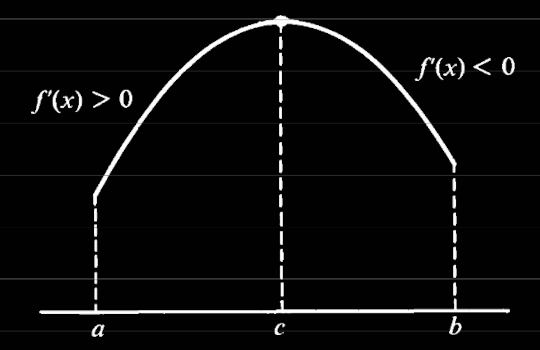
First-Derivative Test
Let be continuous on . Assume is differentiable on except possibly at . Then:
If for all and for all , then has a relative maximum at .
If for all and for all , then has a relative minimum at .
Second-Derivative Test
Let be a critical point of in . Also assume is twice differentiable on . Then: