Let be a field. A vector space over is an abelian group under addition together with an operation of scalar multiplication of each element of by each element of on the left, such that for all and the following conditions hold:
Closure under scalar multiplication. ;
Associativity of scalar multiplication. ;
Scalar multiplication identity. ;
Distributivity I. ;
Distributivity II. .
Let be a vector space. The elements of are vectors and the elements of are scalars.
Subspaces
Let be a vector space over field. If is a vector space over under the same addition and scalar multiplication as , then is a subspace of .
Criterion
A nonempty subset of a vector space is a subspace if and only if
is closed under addition, and
is closed under scalar multiplication.
Sums
Let be a vector space over a field and be subspaces of . Then their sumset (or simply sum) is the smallest subspace of containing each of , denoted as
Unions
Let be a vector space and . Then is a subspace if and only if either or .
Intersections
Let be an indexed set of subspaces of vector space . Then is a subspace of .
Direct Products
Let be vector spaces over a common field. Let and for . Then external direct product is a vector space over under operations
Direct Sums
Let be a vector space over field and . Then sumset is an internal direct sum if each element of can be written in only one way as a sum , where each .
This holds if and only if is uniquely written as .
Linear Maps
Let and be vector spaces over field. A linear map is a homomorphism between vector spaces. That is, a linear map is a function that satisfies the following conditions for all and :
Additivity.
Homogeneity.
Note that is also a group homomorphism so the linked structural properties are preserved. Additionally,
Linear Independence
If is linearly independent, then so is .
If is injective and is linearly independent, then so is .
Subspaces
If , then .
If , then .
Restrictions
Let and . Then is a linear map from to .
Images
Let . Then the image of , denoted , is a subspace of consisting of those vectors of form for some . That is,
Let . Then the kernel of , denoted , is a subspace of consisting of those vectors that maps to . That is,
is injective if and only if . The dimension of the kernel is the nullity of .
Invertibility
Let and be vector spaces. A linear map is invertible (or bijective) if there exists a linear map such that equals the identity map on and equals the identity map on . Such an is a (multiplicative) inverse of .
Let , , and be any vector spaces. Let and . If is invertible, then is surjective and is injective. If and are finite-dimensional with , then is injective if and only if is surjective.
Isomorphisms
An isomorphism is an invertible linear map. Two vector spaces are isomorphic if there is an isomorphism from one vector space onto the other. Two finite-dimensional vector spaces are isomorphic if and only if they have the same dimension.
Linear Map Space
Let and be vector spaces over field. The set of linear maps from to is denoted . This set is a vector space under the following definitions of addition and scalar multiplication:
If and , we define the product as . That is, the product is normal function composition. The product operation satisfies:
Associativity.
Identity. where is the identity map.
Distributivity. and .
A linear map from a vector space to itself is called an operator. The notation denotes the set of all operators on . That is, .
Special Cases
Functions
Let be a field and be a nonempty set. Then , the set of all functions from to , is a vector space under the following operations of addition and scalar multiplication:
Addition. For , is given by .
Scalar multiplication. For and , is given by .
Polynomials
Let be a field. Then , the set of all polynomials with coefficients in , is a vector space under the usual operations of addition and scalar multiplication. Similarly, for any , is also a vector space.
is a subspace of which is a subspace of .
Real Coordinates
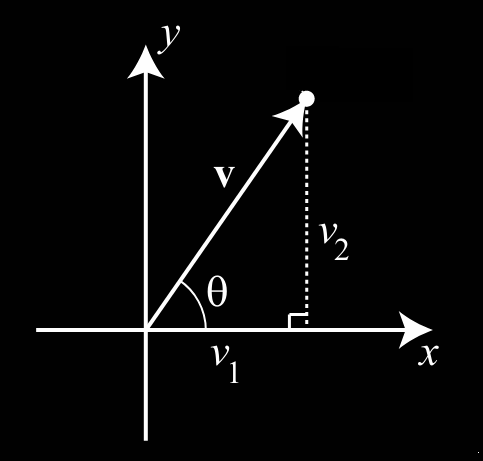
The standard basis vectors in are defined as and . Those in are defined as , , and . This is naturally generalized to vector space for any positive integer .
A vector with initial point at the origin is said to be in standard position.