Decidability
Overview
A Turing machine that halts on all inputs is called a decider. A decider that recognizes some language is said to decide that language. A language is Turing-decidable (or decidable or recursive) if a Turing machine decides it.
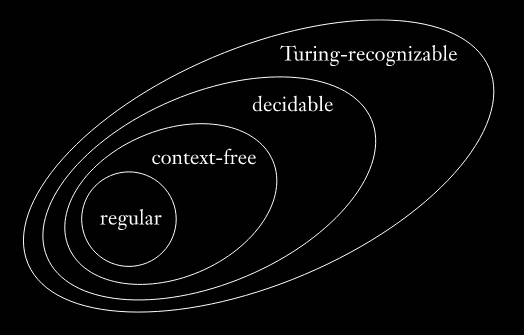
Closure Operations
Let
- Union:
- Intersection:
- Complement:
- Concatenation:
- Kleene Star:
Furthermore, a language is decidable if and only if both it and its complement are Turing-recognizable.
Undecidability
A language is undecidable if no Turing machine can decide it. Proving undecidability is usually done by performing a reduction on an undecidable language.
Halting Problem
The halting problem refers to the problem of determining, from a description of an arbitrary computer program and an input, whether the program will eventually halt. In particular, it refers to the decidability of language
It is the classic example of an undecidable problem.
Post Correspondence Problem
Define a finite collection of dominos
A match is a sequence of dominos
The post correspondence problem is the problem of determining whether such a set of dominos has a match.
Rice's Theorem
Let
- Nontrivial. It is neither empty nor the set of all TM descriptions.
- Extensional. If
, then .
Then