A group is a monoid with inverse elements. That is, for each , there is an element such that . Oftentimes we simply write "a group " with the understanding there is some relevant binary operation on set .
Addition is usually denoted using the symbol. This does not necessarily correspond to the standard additive operation. It is generally reserved for commutative operations. An inverse of in additive notation is denoted as . The identity element is denoted as . For some ,
is interpreted as the identity element.
is interpreted as , where is repeated times.
is interpreted as , where is repeated times.
Multiplication is usually denoted using the symbol or the immediate juxtaposition of two elements. This does not necessarily correspond to the standard multiplicative operation. An inverse of in multiplicative notation is typically denoted as . An identity element is typically denoted as . For some :
is interpreted as the identity element.
is interpreted as , where is repeated times.
is interpreted as , where is repeated times.
A group is abelian if its binary operation is commutative. Otherwise it is nonabelian.
Cancellation
Let be a group and . The left and right cancellation laws respectively state that
These implications prove uniqueness of linear equations.
Order
A group's order refers to the cardinality of its associated set. If the associated set is not finite, the group is said to have infinite order. Up to isomorphism:
Order
Groups
-
, the trivial group
and (or ), the Klein group
By Lagrange's theorem, every group of prime order is cyclic. Hence, there is only one group structure, up to isomorphism, of a given prime order .
Cayley Tables
A Cayley table describes the structure of a finite group by arranging all possible products of all the group's elements in a square table.
A group is abelian if and only if its Cayley table's values are symmetric along its diagonal axis. No row nor column can contain the same element twice.
Subgroups
Let be a group. If is a group under , then is a subgroup of .
An improper subgroup of is itself. Every other subgroup is a proper subgroup. The subgroup , where denotes the identity element, is the trivial subgroup. Every other subgroup is nontrivial.
Criterion
A nonempty subset of a group is a subgroup if and only if
is closed under multiplication, and
is closed under inverses, i.e. .
Product Sets
Let be subsets of a group . Then their product set is defined as
Sumsets
Let be subsets of an abelian group . Then their sumset (or Minkowski sum) is defined as
Unions
Let be a group and . Then is a subgroup of if and only if either or .
This does not generalize to more than two subgroups. For instance, is a union of three of its subgroups.
Intersections
Let be an indexed set of subgroups of . Then their intersection is a subgroup of .
Direct Products
Let be groups. Let for . Then direct product is a group under binary operation
The foregoing definition is referred to as an external direct product. In contrast, a group is an internal direct product of normal subgroups if every is uniquely expressed as where .
Internal Criterion
A group is an (internal) direct product of normal subgroups if and only if each of the following conditions hold:
;
for ;
for each , , .
Furthermore, product set is an (internal) direct product if and only if is uniquely written as .
Decompositions
A group is decomposable if it is isomorphic to a direct product of two proper, nontrivial subgroups. Otherwise is indecomposable.
The finite indecomposable abelian groups are exactly the cyclic groups with order a power of a prime. This follows by the fundamental theorem of finitely generated abelian groups and the fact every cyclic group of order is isomorphic to .
Homomorphisms
Let and be groups. A group homomorphism is a mapping that satisfies the homomorphism property:
Then the following structural properties are preserved:
Identity
If is identity, then is identity.
Inverses
If , then .
Subgroups
If , then .
If , then .
If , then .
If , then .
Images
Let be a group homomorphism. The image of is defined as
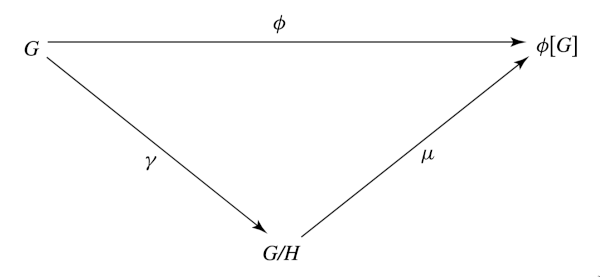
If , then defined as is an isomorphism. This particular isomorphism is called the canonical isomorphism of .
Kernels
Let be a group homomorphism. The kernel of is defined as
The fiber of is the left coset of , where . It also coincides with the right coset of . That is, . Hence the coimage of corresponds to the left (or right) cosets of .
A group homomorphism is injective if and only if .