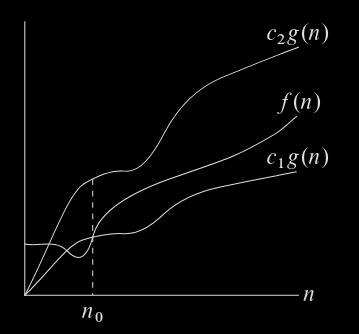
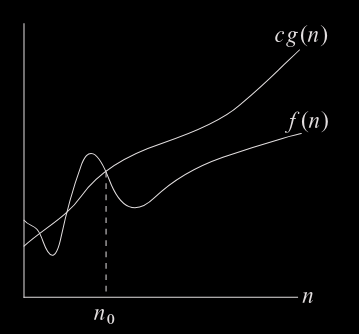
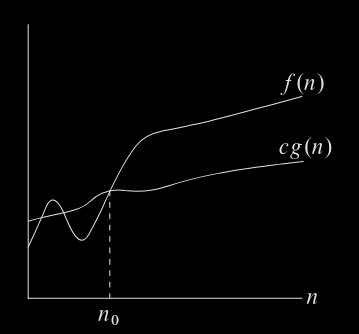
The most commonly used method for analyzing order of growth is asymptotic analysis. Here resources of an algorithm are measured by some function whose leading coefficients and lower-ordered terms are ignored.
Asymptotically Tight
Θ-notation
-notation refers to a strict lower- and upper-bound. It is defined as set
-notation
-notation refers to a strict upper-bound. It is defined as set
Ω-notation
-notation refers to a strict lower-bound. It is defined as set
Asymptotically Loose
-notation
-notation refers to an upper bound that is not asymptotically tight. It is defined as set
Alternatively, we can express -notation using limits. If , then
ω-notation
-notation refers to a lower bound that is not asymptotically tight. It is defined as set
Alternatively, we can express -notation using limits. If , then
Arithmetic
When encountering equations with asymptotic notation on both sides of the equality, we interpret the equation using the following rule:
No matter how the anonymous functions are chosen on the left of the equal sign, there is a way to choose the anonymous functions on the right of the equal sign to make the equation valid.
For example, states that for all , there exists some such that .