Area

Overview

Area is a set function mapping from a class of so-called measurable sets M into the real numbers.

Axioms

We assume there exists a class M of measurable sets in the plane and a set function a, whose domain is M, with the following six properties:

Nonnegative Property

For each SM, a(S)0.

Additive Property

If S,TM, then ST and ST are in M. Also

a(ST)=a(S)+a(T)a(ST).

Notice this last formulation is a special case of PIE.

Difference Property

If S,TM such that ST, then TSM and

a(TS)=a(T)a(S).

This property lets us prove is measurable with the expected area:

a()=a(TT)=a(T)a(T)=0

This property also lets us state the monotone property:

S,TM,STa(S)a(T)

Invariance Under Congruence

If SM and T is shape to S, then TM and a(S)=a(T).

Choice of Scale

Every rectangle R is in M. If the edges of R have lengths h and k, then a(R)=hk.

Exhaustion Property

Let Q be a set. If there exists exactly one c such that a(S)ca(T) for all step regions S and T satisfying SQT, then QM and a(Q)=c.

Regions Between Graphs

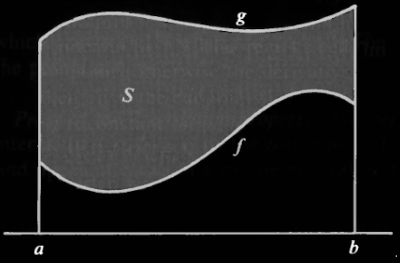
If two functions f and g are related by the inequality f(x)g(x) for all x in an interval [a,b], we write fg on [a,b]. If fg on [a,b], the set S consisting of all points x,y satisfying the inequalities

f(x)yg(x),axb,

is called the region between the graphs of f and g.

regions-between-graphs.png

If f and g are integrable functions on [a,b], then the area of the region between the graphs of f and g satisfies

a(S)=ab[g(x)f(x)]dx

Similarity Transformations

Let S be a set of points on the plane. Let kS denote the set obtained by multiplying the coordinates of each point of S by k>0. Then kS is similar to S and the process by which we produced kS is called a similarity transformation.

Let f be nonnegative and integrable on [a,b]. Let S be its ordinate set. Then for k>0,

a(kS)=k2a(S).
Powered by Forestry.md