Ethernet
Overview
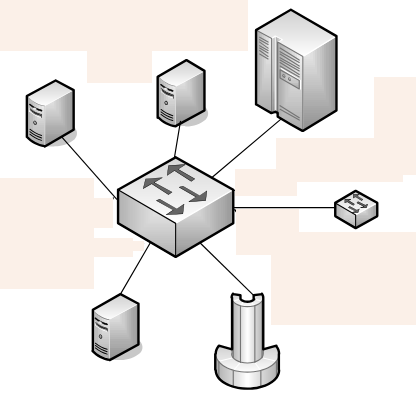
Ethernet refers to (essentially) the IEEE 802.3 set of standards. Network topologies using Ethernet are typically arranged as a star, with an ethernet switch at the center. Every station in a network has a corresponding MAC address used to direct traffic.
MAC
Media access control (MAC) refers to a link layer subprotocol.
A MAC address is a unique identifier assigned to an NIC for use as a network address. Such addresses are typically assigned by the hardware manufacturer. They are represented as six groups of 2 hexadecimal digits, possibly separated by some delimiter (e.g. colons, hyphens, etc.).
A station or node refers to a network interface within a network. Every station has its own unique MAC address.
Frame Format
The following is a diagram of the Ethernet frame format. The size of the payload is typically capped at 1500 bytes, corresponding to the MTU.
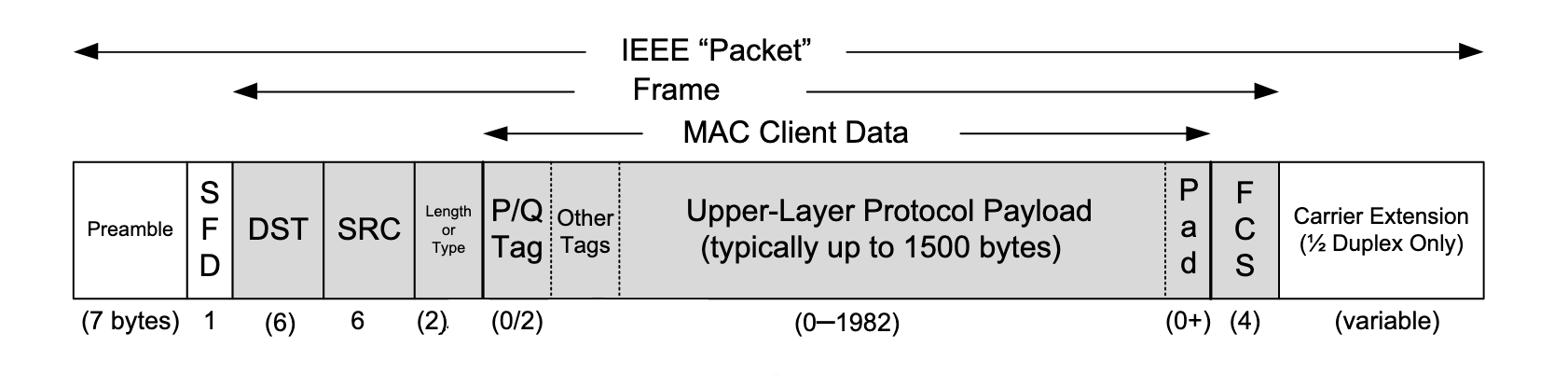
- Preamble. A recognizable pattern which the receiver uses to "recover the clock". Usually has a value of
0xAA. - Start Frame Delimiter (SFD). Indicates the start of the frame. Has a fixed value of
0xAB. - Destination (DST). The 48-bit destination MAC address.
- Source (SRC). The 48-bit source MAC address.
- Length or Type.
- Padding (Pad). Padding in case the payload does not meet the minimum size of 48 bytes.
- Frame Check Sequence (FCS). Used for integrity checking.
VLAN
Virtual LANs (VLAN) refer to the IEEE 802.1q standard. A VLAN is a LAN where network devices are logically grouped regardless of their physical location. This is primarily used to create isolation between different subsets of Ethernet stations connected to the same physical network.
Trunking refers to the connection of VLANs across multiple switches. A trunk cable connects to the switches at their respective trunk ports. Frames broadcasted from a switch is tagged with the corresponding VLAN before being sent along the trunk cable. Connected switches can then examine the tag to decide which ports should be forwarded the frame.