Cardinality
Overview
For any set , the cardinal number of
- For any sets
and , iff . - For a finite set
, is the natural number for which .
Equinumerosity
We say set
Power sets
No set is equinumerous to its power set. This is typically shown using a diagonalization argument. For any set
Equivalence Concept
For any sets
; - if
, then ; - if
and , then .
Notice though that
Finiteness
A set is finite if and only if it is equinumerous to a natural number. The cardinal number of such a set is a finite cardinal. Otherwise we say the set is infinite. The cardinal number of such a set is an infinite cardinal.
Pigeonhole Principle
No natural number is equinumerous to a proper subset of itself. More generally, no finite set is equinumerous to a proper subset of itself. Likewise, any set equinumerous to a proper subset of itself must be infinite.
Arithmetic
Addition
Let
Multiplication
Let
Exponentiation
Let
Ordering
A set
Furthermore,
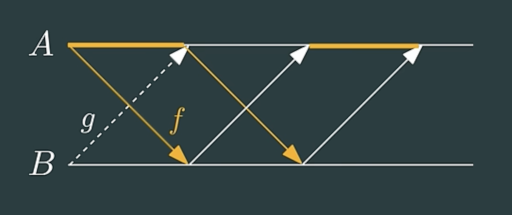
Schröder-Bernstein Theorem
For any sets
Order-Preservation Properties
For cardinal numbers
- If
, then ; - If
, then $\kappa \cdot \mu \leq \lambda \cdot \mu;, - If
, then ; - If
and not both and equal zero, then .
Countable Sets
A set
Union
A countable union of countable sets is countable. More generally, if every member of a set
Sequences
Let
The length of a sequence is its domain.
Alephs
Infinite cardinals are described using alephs.
Continuum Hypothesis
The continuum hypothesis states that there are no sets with cardinality between