Disjoint-Set Data Structures
Overview
A disjoint-set data structure maintains a collection
MAKE-SET(x)- Where
xdoes not belong to some other set, creates a new singleton set containingx.
- Where
UNION(x, y)- Unites two disjoint sets, dynamic sets containing
xandy, into a new set that is the union of these two sets.
- Unites two disjoint sets, dynamic sets containing
FIND-SET(x)- Returns the representative of the set containing
x.
- Returns the representative of the set containing
Linked List
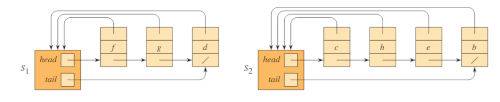
In a standard linked list representation, each disjoint set is represented by an object containing a linked list. The object has a head pointer to the first entry in the list and a tail pointer to the last. Each set member contains a pointer back to the object itself. The representative is the first entry in the list.
MAKE-SET(x)constructs a new linked list containing just thexentry.FIND-SET(x)follows the pointer fromxback to the linked list.UNION(x, y)moves the entries ofyto the end ofx.
The UNION operation can be improved via the weighted-union heuristic in which the shorter list is always appended to the longer list.
Disjoint-Set Forest
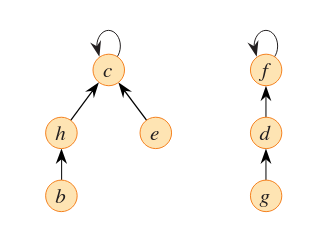
In a disjoint-set forest representation, each disjoint set is represented by a tree. The members of the set correspond to nodes in the tree. Each node points only to its parent, and the root node is its own parent. The representative of the set is the root of the tree.
MAKE-SET(x)constructs a new tree containing justxas the root.FIND-SET(x)follows the parent pointers starting atxup to the root.UNION(x, y)updates the root ofyto point to the root ofx.
The UNION operation can be improved via two heuristics:
- Union by rank. Each node maintains a rank corresponding to the upper bound on the height of the node. Roots with smaller rank point to roots with larger rank during a
UNIONoperation. - Path compression. Each node on the find path, the path from a node up to its root, is updated to point to the root during a
FIND-SEToperation.