Circular Functions

Overview

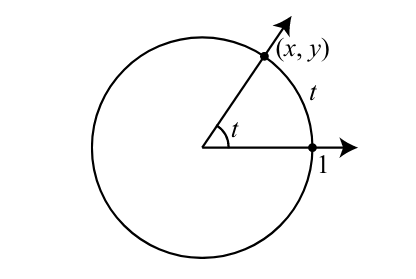
There exists a duality between the use of sin, cos, and other related functions. They are technically called circular functions when they use arc lengths as inputs and technically called trigonometric functions when they use angles as inputs. The relationship between the two is so close, the terms are safe to use interchangeably.

circular-trigonometric.png

Sine

If the real number t is the directed length of an arc (either positive or negative) measured on the unit circle x2+y2=1 (with counterclockwise as the positive direction) with initial point 1,0 and terminal point x,y, then the sine of t, denoted sin(t) is defined to be

sin(t)=y.

For any point x,y other than the origin on the terminal side of an angle θ in standard position,

sinθ=yr,r=x2+y2.

The sine function is periodic with period 2π.

Cosine

If the real number t is the directed length of an arc (either positive or negative) measured on the unit circle x2+y2=1 (with counterclockwise as the positive direction) with initial point 1,0 and terminal point x,y, then the cosine of t, denoted cos(t), is defined to be

cos(t)=x.

For any point x,y other than the origin on the terminal side of an angle θ in standard position,

cosθ=xr,r=x2+y2.

The cosine function is periodic with period 2π.

Tangent

The tangent function is the quotient of the sine function by the cosine function. For real number t0,

tan(t)=sin(t)cos(t).

For any point x,y other than the origin on the terminal side of an angle θ in standard position,

tanθ=yx.

The tangent function is periodic with period π.

Secant

The secant function is the reciprocal of the cosine function. That is, for any real number t,

sec(t)=1cos(t).

For any point x,y other than the origin on the terminal side of an angle θ in standard position,

secθ=rx,r=x2+y2.

The secant function is periodic with period 2π.

Cosecant

The cosecant function is the reciprocal of the sine function. That is, for any real number t,

csc(t)=1sin(t).

For any point x,y other than the origin on the terminal side of an angle θ in standard position,

secθ=ry,r=x2+y2.

The cosecant function is periodic with period 2π.

Cotangent

The cotangent function is the reciprocal of the tangent function. That is, for any real number t,

cot(t)=1tan(t)=cos(t)sin(t).

For any point x,y other than the origin on the terminal side of an angle θ in standard position,

cotθ=xy.

The cotangent function is periodic with period π.

Identities

Symmetries

The sine and tangent functions are odd whereas the cosine function is even.

Pythagorean Identity

For any real number t, cos2(t)+sin2(t)=1.

Phase Shift

For any real number t,

sinx=cos(xπ2)cosx=sin(x+π2)

We say the cosine function is leading (corresponding to a negative phase shift) and the sine function is lagging (corresponding to a positive phase shift).

Law of Sines

If a, b, and c are the lengths of the sides of a triangle opposite angles α, β, and γ respectively, then

sinαa=sinβb=sinγc.

Law of Cosines

If a, b, and c are the lengths of the sides of a triangle and θ is the angle between the sides a and b, then

c2=a2+b22abcosθ.

Derivatives

The following outlines the derivatives of each of the circular functions:
Function Derivative
sinx cosx
cosx sinx
tanx sec2x
cotx csc2x
secx (secx)(tanx)
cscx (cscx)(cotx)
Powered by Forestry.md