Then is called the epsilon-image (denoted -image) of the well-ordered structure. The name "-image" derives from the fact that is well ordered by epsilon.
Transitive Sets
A set is said to be transitive iff every member of a member of is itself a member of . We can equivalently express this using any of the following formulations:
A transitive class is a class in which every member of a member of is itself a member of .
Let be the -constructed function on . Then is the transitive closure of . is a transitive set and .
Ordinal Numbers
Let be a strict well ordering on a set . The ordinal number of is its -image. An ordinal number is a set that is the ordinal number of some well-ordered structure.
An -image (and therefore an ordinal number) is a transitive set. Let be any transitive set that is well ordered by epsilon. Then is an ordinal number. In fact, is the -image of .
There is no set to which every ordinal number belongs.
Hartogs's Theorem
For any set , there is an ordinal not dominated by . The Hartogs number of is the least ordinal such that . This ordinal is always a cardinal.
Limit Ordinals
Ordinals are categorized in one of three ways:
Zero, the ordinal .
The successor ordinals which are those of form for some ordinal .
The limit ordinals which constitute all remaining ordinals.
Initial Ordinals
An initial ordinal is an ordinal number that is not equinumerous to any smaller ordinal number. The initial numbers and cardinal numbers are therefore exactly the same thing.
Rank
For any ordinal number , use transfinite recursion to define function with domain such that, for all ,
For ordinal number , define as the set for some greater than . Therefore,
This can be written more compactly as:
.
for any ordinal number .
for any limit ordinal .
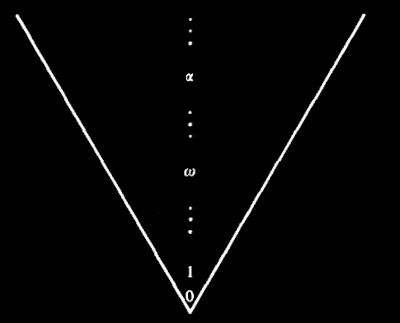
This cumulative hierarchy of stes indexed by the class of ordinal numbers is known as the von Neumann universe. A set is grounded if for some ordinal number . The rank of a grounded set, denoted , is the least such ordinal .
Regularity
Let be a set. We say is regular if is empty or has a member such that .
A set is grounded if and only if it is regular. This latter assertion, applied to the universe of all sets, is known as the regularity axiom.