A scalar is a quantity that has a magnitude only whereas a vector is a quantity that has both magnitude and direction. Compare this definition with those used in the more abstract sense used when defining vector spaces.
Vectors are typically depicted as an arrow, i.e. a directed line segment. The arrowhead indicates the direction of the vector whereas the length of the arrow describes the magnitude of the vector.
The zero vector is the vector with magnitude and no direction.
Norm
The norm of a vector , denoted as , refers to its magnitude.
Component Form
Consider vector space over field . The component form of a vector corresponds to the explicit listing of each component as an -tuple
Each component denotes the direction moves along the th component of its relative basis.
Properties
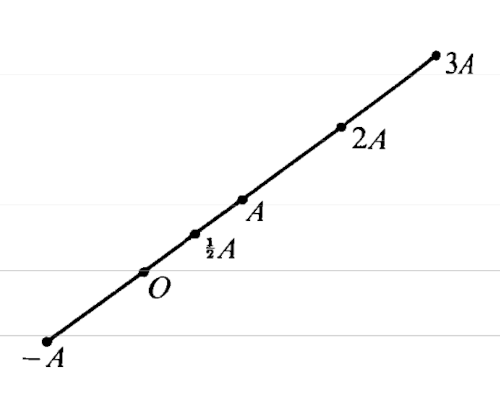
Scalar Multiplication
Consider vector space over field . Scalar multiplication in refers to multiplication of a scalar by a vector such that
Two vectors are said to have the same direction if for some positive and to have the opposite direction if for some negative . They are called parallel if for some nonzero .
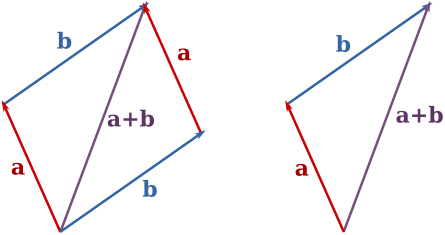
Addition
Consider vector space over field . Let . Then addition of and yields the resultant, defined using component-wise addition:
Visually, the resultant is determined by positioning the vectors such that the initial point of coincides with the terminal point of . In , is visualized using the parallelogram rule or triangle rule.
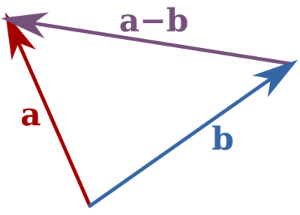
Subtraction
Consider vector space over field . Let . Then subtraction of and yields the difference between and , defined as:
Visually, the difference is determined by positioning the vectors by placing the tails of and at the same point, and then drawing a vector from the head of to the head of .
Dot Product
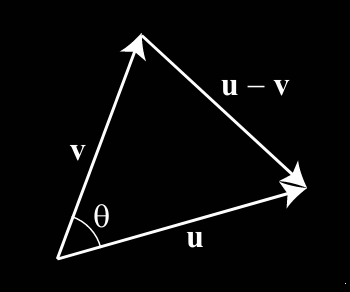
Let and be members of vector space. Then the dot product of and is defined as
If is the angle between two nonzero vectors and , then
Two vectors are orthogonal if and only if their dot product equals .