Calculus
Overview
Calculus is the mathematical study of continuous change. It is largely broken into two main branches: integral calculus and differential calculus. The central idea of the former is the integral. The central idea of the latter is the derivative.
Completeness Axiom
A particularly fundamental axiom used in building up a theory of calculus is the completeness axiom which states:
Every nonempty set
of real numbers which is bounded above has a supremum.
Archimedean Property
If
Fundamental Theorem of Calculus
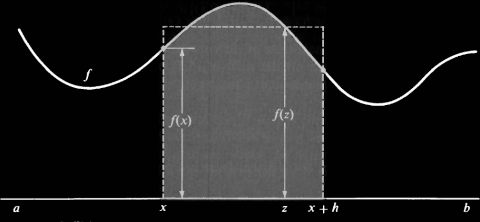
The fundamental theorem of calculus is used to connect the concepts of differentiation and integration together, showing they are effectively inverse operations of one another. It also provides a much simpler method of computing Riemann integrals.
Part One
Let
Then for all
Part Two
Assume