A function whose domain is the set of natural numbers is called an (infinite) sequence. The function value is called the th term of the sequence. Sequences are described using one of:
Closed Formulas. A formula that can be computed using a fixed number of "well-known" standard operations.
Recursive Definitions. Consists of initial conditions and a recurrence relation.
We often denote a sequence as where for all . Other index patterns are denoted in the natural way.
A tail of refers to the sequence with a finite number of initial terms omitted.
Convergence
A sequence is said to have a limit if, for every , there exists an such that
In this case, we say the sequence converges to and we write
A sequence which does not converge is called divergent.
Algebraic Limit Theorem
The following identities assume and are convergent sequences such that
If ,
Monotone Convergence
A monotonic sequence is convergent if and only if it is bounded.
An increasing sequence is sometimes denoted as . A decreasing sequence is sometimes denoted as .
Asymptotic Equality
Two sequences and of complex numbers are said to be asymptotically equal if
This relation is denoted as as .
Limit Functions
Let denote a sequence of real- or complex-valued functions having a common domain on the real line or in the complex plane. Let denote the set of points for which sequence converges. The function defined on by the equation
is called the limit function of the sequence . We say the sequence converges pointwise to on the set .
Uniform Convergence
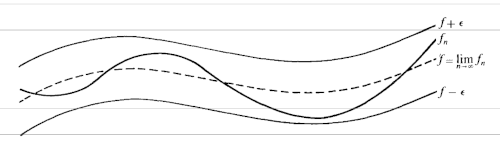
A sequence of functions converges uniformly to on a set if for every there is an such that implies
We denote this symbolically by writing " uniformly on ."
Continuity
Assume uniformly on an interval . If each function is continuous at a point in , then the limit function is also continuous at .
Integration
Assume uniformly on an interval , and assume each is Riemann integrable on . Define a new sequence by the equation
Then is Riemann integrable and uniformly on . That is,
Differentiation
Unlike integration, differentiability is not transmitted by uniform convergence. One notable exception to this rule is within a power series's circle of convergence.
Special Cases
∆ᵏ-constant Sequence
Let be a sequence. We define the th differences of recursively:
The th differences of is .
The th differences of is the sequence given by subtracting consecutive terms of the differences of .
A sequence is said to be -constant if the th differences are constant. The closed formula for a sequence will be a degree polynomial if and only if the sequence is -constant.